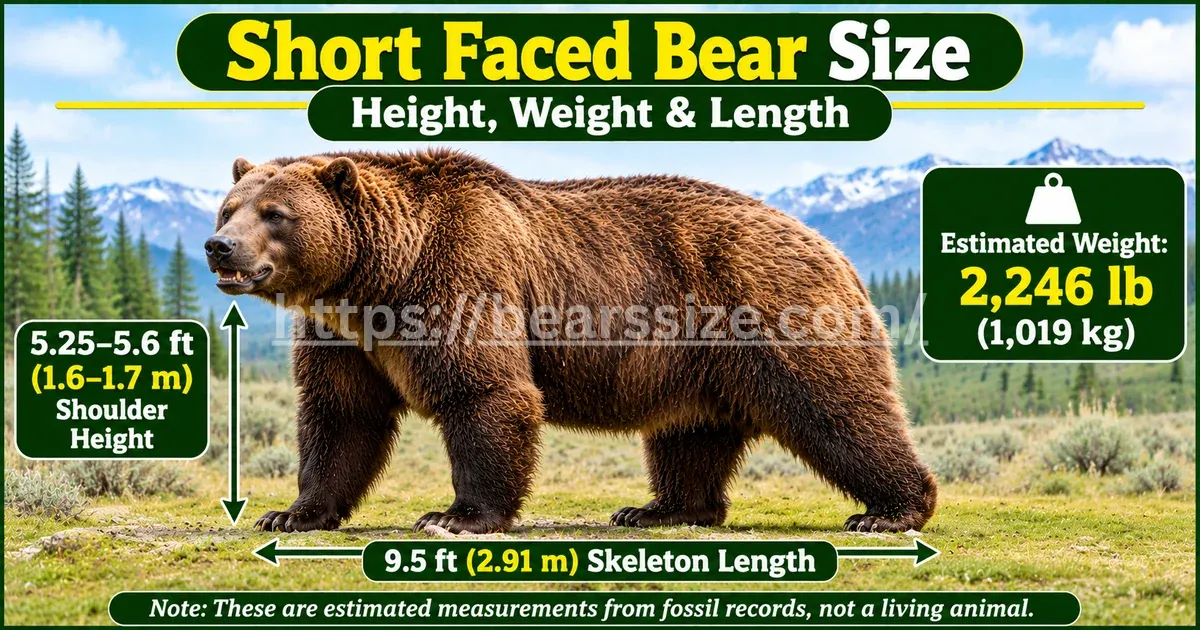
The giant short faced bear (Arctodus simus) was about 11 feet tall standing, about 5 feet tall at the shoulder, and 1,500 pounds or more. It was the largest land carnivore ever to live in North America, according to the University of Iowa Museum of Natural History. It lived from about 1.6 million to 11,000 years ago.
Here are the height, weight and length figures, how the bear compared to other animals, and why the numbers change from source to source.
Short Faced Bear Size Chart
| Measure | Estimate |
|---|---|
| Standing height | 10–12 ft (about 3–3.7 m) |
| Shoulder height | 5–6 ft (about 1.5–1.8 m) |
| Body length | 8–10 ft (about 2.4–3 m) |
| Weight | 1,000–2,000 lb (about 450–900 kg) |
| Running speed | Possibly over 40 mph (disputed) |
More Post: Kodiak Bear Size
Short Faced Bear Height
Standing Height on Hind Legs
The short faced bear stood about 11 feet tall on its hind legs. The North American Bear Center says up to 12 feet. The Iowa Museum says over 11 feet. The difference comes from the individual bear. The largest males reached the top of the range.
For a clear picture, a basketball hoop is 10 feet high. A big male could look down at it.
Shoulder Height on All Fours
On all fours, the bear stood about 5 feet tall at the shoulder. That put its eyes level with a tall adult. Modern bears are lower and heavier. The short faced bear had long legs and toes that pointed straight ahead. This made it tall and built for fast travel on open ground.
Short Faced Bear Weight & Length
Short Faced Bear Weight
Most estimates put the short faced bear weight at 1,500 pounds or more. One widely cited estimate puts the average near 1,540 pounds. Some researchers say the biggest males passed a ton.
Males and females differed a lot. This is called sexual dimorphism. One estimate puts females at about 660–880 pounds. A male tibia found in Iowa in 2008 sat at the upper end of the known size range.
Short Faced Bear Length
The short faced bear length was about 8 to 10 feet, nose to rump. The tail was tiny. Its torso was also shorter than that of many bears, so its long legs made it look even bigger.
Most competitors skip this number. Yet it matters when you compare the bear to a car or a modern grizzly.
Why Short Faced Bear Size Estimates Vary
Scientists build body-size estimates from limb bones, such as the tibia, femur and pelvis. They then compare them with living bears. That method has limits:
- Fossils are incomplete. Few full skeletons exist.
- Short faced bear limbs were unusually long. Grizzly formulas can overestimate weight.
- Fat leaves no mark on bone. Seasonal weight can’t be measured.
- Two subspecies (A. simus yukonensis and A. simus simus) differed in size.
The giant short faced bear was not the biggest bear ever. A South American relative, Arctotherium angustidens, is often estimated to have been larger.
More Post: Grizzly Bear Size
Short Faced Bear Size Compared to Other Animals
Short Faced Bear vs Grizzly Bear
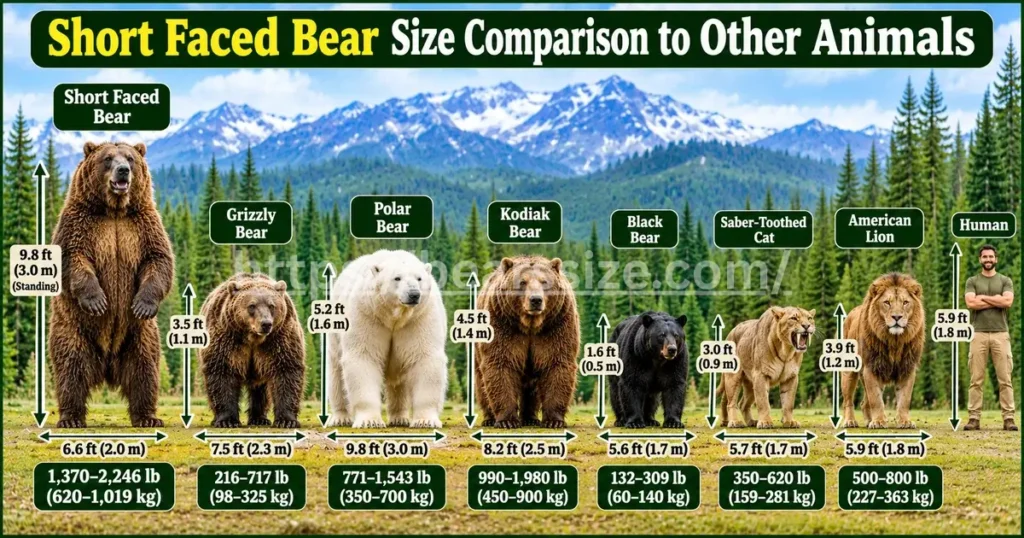
A grizzly’s skull is big enough to take a human. The short faced bear skull was much larger. A big grizzly may weigh half as much and stand a few feet shorter.
Short Faced Bear vs Polar Bear
The polar bear is the largest living land carnivore. Some big males match the short faced bear in weight. The short faced bear was taller and leggier, while the polar bear is longer and more heavily built.
Short Faced Bear vs Kodiak Bear
The Kodiak is the largest brown bear. Big males can match smaller short faced bears. The extinct bear still held the edge in shoulder height and leg length.
Short Faced Bear vs Black Bear
The black bear is the bear most Americans know. A big male is about a third of the short faced bear’s weight. The only living relative, the spectacled bear of South America, is about black bear size.
Short Faced Bear vs Saber-Toothed Cat
The saber-toothed cat was far smaller. Experts say a pack might have gone after a young short faced bear. An adult was rarely at risk.
Short Faced Bear vs American Lion
The American lion was among the biggest cats ever, but it was still lighter and lower than the bear. The two competed for the same large prey and carcasses.
Short Faced Bear vs a Human
An adult short faced bear standing upright was about twice the height of an average adult. On all fours, it could look a tall person in the eye.
More Post: Black Bear Size
Why Short Faced Bear Size Mattered
Long Legs, Speed & Build
The short faced bear may have run over 40 miles per hour, according to the North American Bear Center. Scientists debate that number. Still, its long, straight legs were built for running, not climbing. Wide-set eyes, a keen sense of smell and a powerful bite made it a strong hunter and a bold scavenger.
Size, Diet & Hunting
Diet is still debated. Isotope tests suggest a true carnivore in some regions. Other studies found cavities in bears from southern California, which points to a mixed diet. Some experts also say it scavenged carcasses, where its sheer bulk scared off rivals.
Short Faced Bear Size & Extinction
The short faced bear died out about 11,000 years ago. Climate change, human hunting, loss of large prey and wildfires all played a part. A huge body needs a lot of food. When big prey vanished, size became a burden.
More Post: Polar Bear Size
FAQ’s About Short Faced Bear Size
How big was the short faced bear?
It stood about 11 feet tall on its hind legs and weighed around 1,500 pounds. It was the largest land carnivore in North America.
How tall was the giant short faced bear standing up?
About 11 feet, with some sources saying up to 12 feet. On all fours, it was about 5 feet at the shoulder.
How much did a short faced bear weigh?
Most estimates fall between 1,000 and 2,000 pounds. Males were much heavier than females.
Was the short faced bear bigger than a polar bear?
Yes, usually. It was taller, and the biggest males were likely heavier. Some large polar bears come close in weight.
Was the short faced bear the largest bear ever?
No. A South American relative, Arctotherium angustidens, is often estimated to have been larger. Still, it is the biggest known North American bear.
How fast could the short faced bear run?
Possibly over 40 miles per hour, according to one bear research center. Other researchers think it was slower.

I’m Ethan Parker, a writer focused on animals and wildlife. I share simple, useful facts about animal size, behavior, habitats, and unique traits.