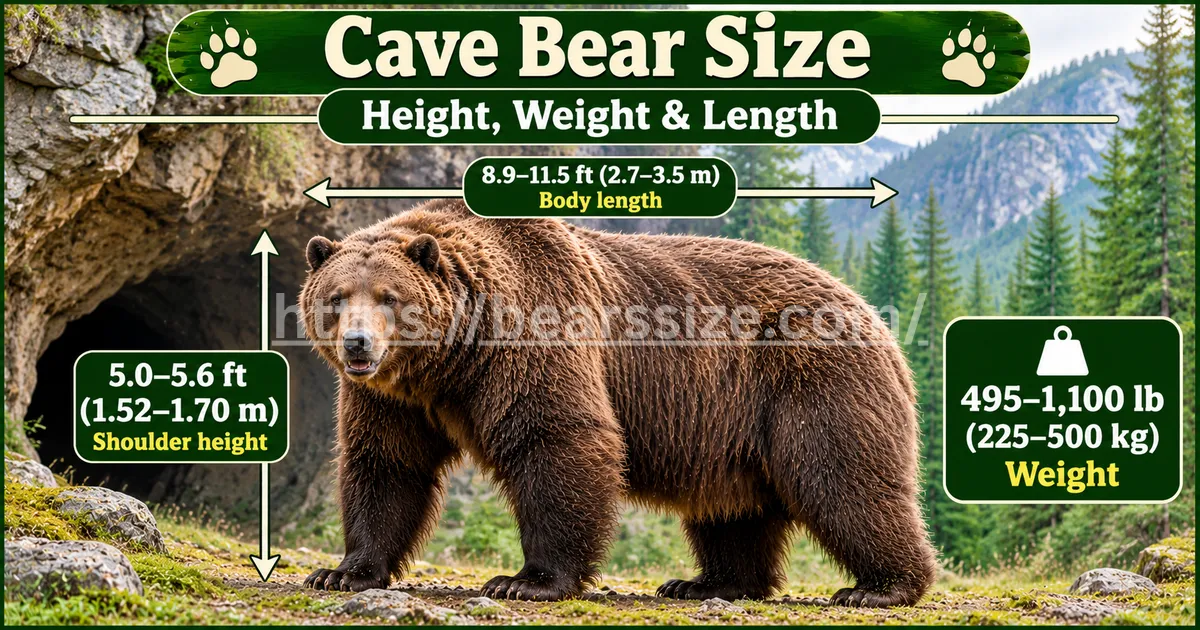
How big was a cave bear? Adult cave bears weighed about 880 to 2,200 pounds and reached nearly 10 feet long or tall when standing. That puts Ursus spelaeus in the same size class as a Kodiak or polar bear.
This guide explains each measurement, how scientists found it, and how it compares to bears you know.
Cave Bear Size Chart
| Measure | Cave bear (adult) |
|---|---|
| Weight | About 880 to 2,200 lb (400 to 1,000 kg) |
| Length | Up to about 10 ft |
| Standing height | Close to 10 ft on hind legs |
| Shoulder height | Roughly 4 to 5 ft (estimate) |
Cave Bear Height
Cave bear height depends on how the bear stood. On all fours, it was around waist-high to a tall adult. On its hind legs, the biggest males reached close to 10 feet.
Many sources mix these two numbers. The “10 feet” figure is a standing height, not shoulder height.
Cave Bear Weight
Cave bear weight ranged from about 880 to 2,200 pounds. Most adults sat well below the top figure. The 2,200-pound mark describes rare, very large males.
A bear also weighed more in autumn than in spring. It packed on fat before winter sleep.
Cave Bear Length
Cave bear length reached about 10 feet from nose to tail. The head was very large, with a steep, domed forehead and a heavy jaw. This gave the animal a massive, barrel-chested build.
More Post: Sun Bear Size
Male vs Female Cave Bear Size
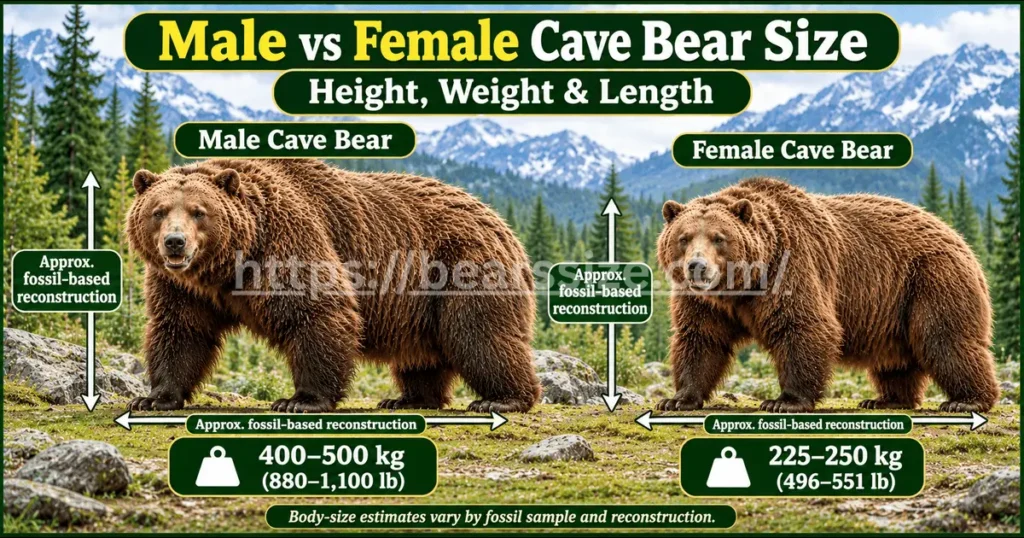
Were male cave bears bigger than females? Yes. Males were much larger. Males could reach about 1,000 pounds, while females weighed around 500 pounds or less.
Sexual Dimorphism in Cave Bears
Scientists call this size gap sexual dimorphism. Males likely grew larger to win mates and defend territory. Females stayed smaller, which suited raising cubs in tight caves.
The gap is so clear in fossils that small female skeletons were once mistaken for a separate, dwarf form.
Regional and Dwarf Cave Bear Sizes
Cave bear size was not the same everywhere. Fossils from England, Belgium, Germany, Russia, Spain, Italy, and Greece show local races. Some regions even had dwarf cave bears.
Cubs and young bears were far smaller. Cave deposits hold many very young and very old bears, so the size range in fossils is wide.
More Post: Short Faced Bear Size
How Scientists Measure Cave Bear Size
Fossil Skeletons and Bone Measurements
Experts measure limb bones, skulls, and teeth to estimate body mass. Thick leg bones point to heavy bodies. Caves also preserve bones well, so the record is strong. More than 100,000 cave bear remains have been found in Europe.
Scientists have even rebuilt DNA from a cave bear bone over 300,000 years old, found in Spain’s Sima de los Huesos cave. This tied the species to its deep family history.
Why Cave Bear Size Estimates Differ
Figures vary for three simple reasons:
- Bones show frame size, not fat.
- Season changes weight by a lot.
- Some sources give length, others give standing height.
So a single “cave bear weight” is always an estimate, not an exact number.
More Post: Kodiak Bear Size
Cave Bear Size Compared to Other Animals
Cave Bear vs Kodiak Bear Size
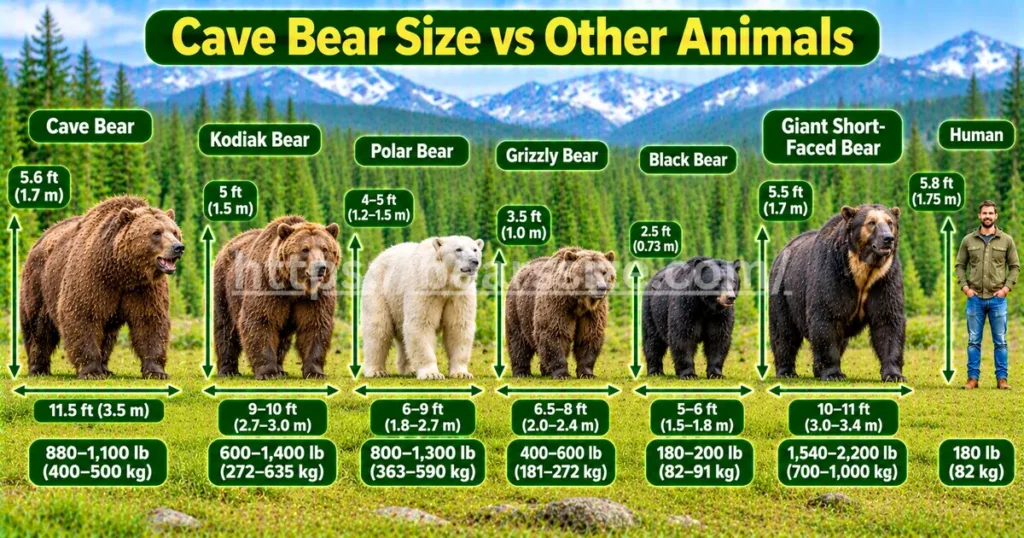
The Kodiak is the largest brown bear today. The biggest cave bears were comparable in size to it. Most cave bears sat in the same weight range.
Cave Bear vs Polar Bear Size
The polar bear is the largest living land carnivore. Large cave bears matched big polar bears in weight and length. Polar bears are leaner and longer-bodied. Cave bears were bulkier.
Cave Bear vs Grizzly Bear Size
A typical grizzly is smaller. Most grizzlies weigh well under 1,000 pounds. An average cave bear male was heavier and broader.
Cave Bear vs Black Bear Size
The American black bear is far smaller. A big cave bear could weigh three or four times as much.
Cave Bear vs Giant Short-Faced Bear Size
The giant short-faced bear lived in Ice Age North America. It was taller and longer-legged. The cave bear was more heavily built. Both were among the biggest bears ever.
Cave Bear vs Human Size
Standing, a large cave bear towered over a grown person by about four feet. It also weighed four to ten times more than an average adult.
Why Cave Bears Grew So Large
Diet, Hibernation, and Body Size
Cave bears ate mostly plants, seeds, and tubers. Tooth wear shows this. They were also opportunistic omnivores. Ice Age winters were harsh, so a large body with thick fat stores helped them survive long hibernation.
Cave Bear Size and Extinction
Size had a cost. One study links the bear’s enlarged sinuses to better survival during winter sleep. The same change gave it a thinner skull and weaker bite. That limited it to softer, low-value foods.
Cave bears died out between roughly 28,000 and 24,000 years ago, depending on the study. Human hunting was rare and is unlikely to be the main cause.
More Post: Grizzly Bear Size
FAQ’s About Cave Bear Size
How big was a cave bear?
Adults weighed about 880 to 2,200 pounds and reached nearly 10 feet. That matches a Kodiak or polar bear.
How tall was a cave bear standing up?
Large males reached close to 10 feet on their hind legs. On all fours, shoulder height was roughly 4 to 5 feet.
Was the cave bear bigger than a grizzly bear?
Yes, usually. Most grizzlies weigh under 1,000 pounds, while many cave bears weighed more.
Was the cave bear bigger than a polar bear?
They were about equal. The largest cave bears matched the largest polar bears in weight.
How much did a cave bear weigh?
Between 880 and 2,200 pounds. Sex, age, and season changed the number.
Were male cave bears bigger than females?
Yes. Males reached about 1,000 pounds, while females stayed near 500 pounds or less.
Did cave bears live in North America?
No. Their fossils come from Europe and parts of Asia. Americans know them mainly through museum fossils.

I’m Ethan Parker, a writer focused on animals and wildlife. I share simple, useful facts about animal size, behavior, habitats, and unique traits.