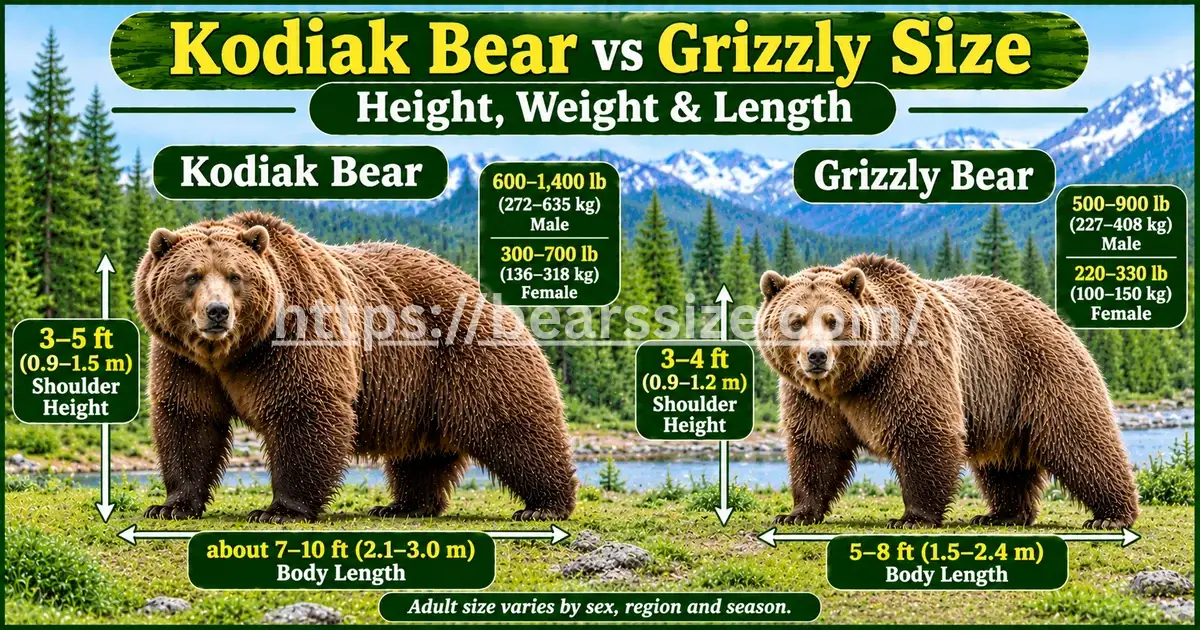
Are Kodiak bears bigger than grizzlies? Yes. A Kodiak bear is the largest brown bear subspecies on Earth. Adult males often weigh 600 to 1,400 lb (272 to 635 kg), while most grizzly males weigh 400 to 800 lb (180 to 360 kg).
This guide shows the Kodiak bear vs grizzly size gap in weight, height, and length. You will also learn why Kodiaks grow so big, how they compare to other animals, and where to see them in the US.
Kodiak Bear vs Grizzly Size Comparison Chart
| Measurement | Kodiak Bear | Grizzly Bear |
|---|---|---|
| Adult male weight | 600–1,400 lb (272–635 kg) | 400–800 lb (180–360 kg) |
| Adult female weight | 400–700 lb (181–318 kg) | 200–400 lb (90–180 kg) |
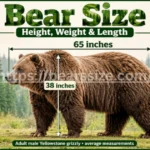
| Shoulder height (on all fours) | About 4–5 ft | About 3.5–4.5 ft |
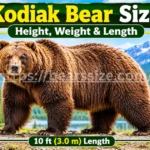
| Standing height | Up to 10 ft | About 6–8 ft |
| Body length | About 6.5–8.5 ft | About 5–7.5 ft |
| Subspecies | Ursus arctos middendorffi | Ursus arctos horribilis |
| Population | About 3,500 | About 30,000 in Alaska, about 2,000 in the lower 48 |
Figures are typical ranges. Individual bears vary.
Kodiak vs Grizzly Weight
Kodiak bear weigh: Most adult males weigh 600 to 1,400 lb. Some very large males pass 1,500 lb in fall.
Grizzly bear weigh: Most males weigh 400 to 800 lb. Grizzlies near the coast and salmon rivers can weigh more than inland ones.
That is why sources give different numbers. Inland grizzlies, coastal grizzlies, and the season all change the scale reading.
Kodiak vs Grizzly Height and Length
On all fours, a Kodiak stands about 4 to 5 ft at the shoulder. Standing on its hind legs, a big male can reach about 10 ft. A grizzly usually reaches 6 to 8 ft.
Bears rarely stand fully upright, though. They do it to sniff the air or get a better look. So treat standing height as a rough guide.
Male vs Female Size Difference
Male bears are much bigger than females. This is called sexual dimorphism. A Kodiak female is about 20 to 30% lighter than a male.
Here is a fun fact. A big female Kodiak can weigh about the same as a male grizzly.
Seasonal Weight Changes
A bear’s weight swings through the year. In spring, bears are lean after months in the den. By late summer, they feast on salmon and berries.
A Kodiak can gain hundreds of pounds before winter. So a spring weight and a fall weight for the same bear can differ a lot.
Paw, Skull, and Claw Size
Kodiak bears have a broader skull and a bigger frame. Their paws are wide and heavy. Their claws can reach 4 inches or more, and they use them for digging and fishing.
Grizzly claws are long too. They are shaped for digging roots and dens. The shoulder hump on both bears is pure muscle.
More Post: Black vs Grizzly Bear Size: Comparison Chart
Why Kodiak Bears Are Bigger Than Grizzlies
Island Isolation on the Kodiak Archipelago
Rising seas cut the Kodiak islands off from the mainland about 12,000 years ago. Since then, the bears there have bred only with each other. They became a distinct subspecies.
Think of dog breeds. A Labrador and a Beagle are the same species, but they look different. Kodiaks and grizzlies work the same way.
Salmon-Rich Diet vs Inland Grizzly Diet
Kodiaks feast on fatty salmon, plus berries, sedges, and grasses. Salmon is packed with fat and protein. That helps them bulk up fast.
Inland grizzlies eat roots, berries, insects, and small mammals. These foods have fewer calories. So inland bears tend to stay lighter.
Mild Climate and Abundant Food
The Kodiak Archipelago has a mild, wet coastal climate. Plants grow well, and salmon runs are strong. Bears have a long feeding season.
Food is easy to find, so bears waste less energy. More energy goes into growth and fat.
Do Genetics or Environment Matter More?
Both play a part. Genes set the frame. Food builds the body.
Here is the proof. Coastal grizzlies in Alaska that eat salmon also grow very large. They get closer to Kodiak size than inland grizzlies do. So diet clearly matters a lot.
More Post: Polar Bear vs Human Size, Height & Weight Comparison
Kodiak Bear vs Grizzly Size Compared to Other Animals
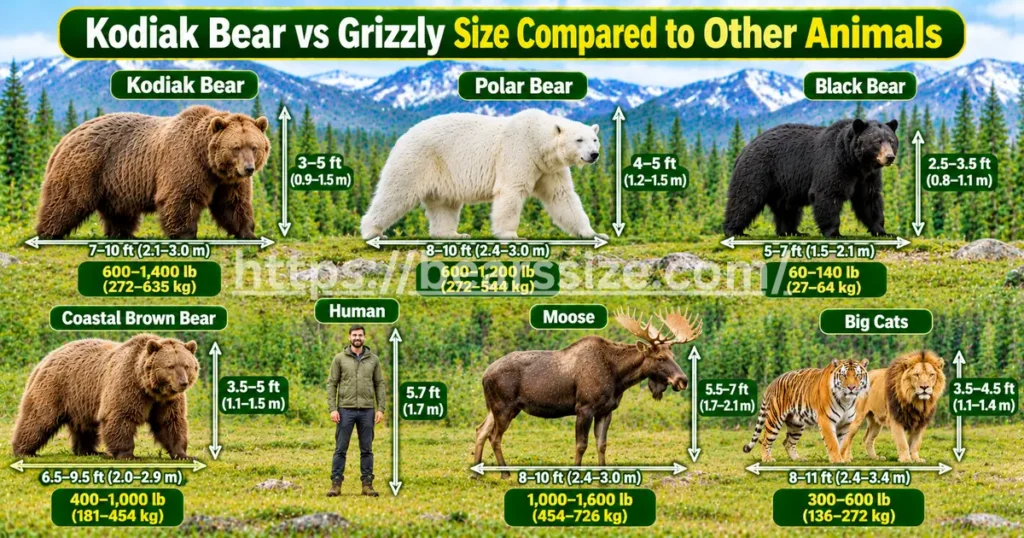
Kodiak Bear vs Polar Bear
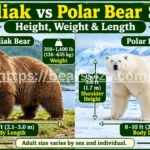
The polar bear is the largest bear and the largest land carnivore. Males usually weigh 900 to 1,500 lb. A few exceed that.
Kodiaks are the largest brown bears and come close. A big Kodiak can match a small polar bear.
Kodiak Bear vs Black Bear
American black bears are much smaller. Males usually weigh 150 to 600 lb. A large Kodiak can weigh three to five times more than an average black bear.
Kodiak Bear vs Coastal Brown Bear
Coastal brown bears live along the Alaska Peninsula, such as at Katmai. They are also big. Males often weigh 600 to 1,200 lb.
“Grizzly” and “brown bear” are the same species. The name often depends on where the bear lives, not how big it is.
Kodiak Bear vs Humans, Moose, and Big Cats
An average US adult man weighs about 200 lb. A big Kodiak can weigh seven times that.
Compare it with cats. A large male lion weighs about 420 lb. A big Siberian tiger weighs up to about 660 lb. A Kodiak can outweigh both.
Moose and bison are different. A big bull moose can top 1,000 lb. A bull bison can weigh about 2,000 lb.
More Post: Kodiak vs Polar Bear Size: Comparison Chart
FAQ’s About Kodiak Bear vs Grizzly Size
Are Kodiak bears bigger than grizzly bears?
Yes, on average. Kodiak males often weigh 600 to 1,400 lb, while grizzly males weigh about 400 to 800 lb.
How much bigger is a Kodiak bear than a grizzly?
A Kodiak is often several hundred pounds heavier. Large males can be nearly twice the weight of an average inland grizzly.
How tall is a Kodiak bear compared to a grizzly?
A Kodiak can stand up to 10 ft on its hind legs. A grizzly usually stands 6 to 8 ft.
Is a Kodiak bear the largest bear in the world?
It is the largest brown bear. The polar bear is the largest bear overall.
Are Kodiak bears and grizzlies the same species?
Yes. Both are brown bears (Ursus arctos). They are different subspecies.
What is the biggest Kodiak bear ever recorded?
Reports of wild Kodiaks above 1,500 lb exist. Exact records vary, and weights are often estimates.
Do Kodiak bears weigh more in fall than spring?
Yes. They gain much weight on salmon and berries before winter. They lose weight while denning.

I’m Ethan Parker, a writer focused on animals and wildlife. I share simple, useful facts about animal size, behavior, habitats, and unique traits.